
A business can do excellent work and still be overlooked by people who would gladly become customers. Visibility is often treated as a question of how many people see an ad. For a local business, a more useful question is: Are the right people seeing you often enough, in places that matter to them, to remember you when they need what you offer? That question changes how we plan.
Southwest Michigan businesses serve different communities, even within the same city. A contractor may need to become known to homeowners in a few neighborhoods. A restaurant may want to reach people who spend their lunch hour nearby. A regional employer may need visibility across several markets. The strongest plan starts by defining those people and places before choosing a channel.
Start with the market you can actually serve. Write down the geographic area where a new customer would be valuable and practical to serve. A broad label like “Southwest Michigan” can hide important differences between Kalamazoo, Portage, Battle Creek, and Benton Harbor. If your team can only handle appointments within a short drive, begin there. If you are opening another location, create a separate plan for that market rather than assuming the same message and placement will work everywhere.
Then define the customer with more care than an age bracket. What problem are they trying to solve? What event prompts them to act? What would make them trust you? An auto service business might want commuters who need reliable maintenance; a neighborhood café might want workers planning lunch. Those are different moments of need, even if the customers are the same age.
Choose places that fit the customer’s routine. Once you know whom you want to reach, consider where those people already spend time: shopping centers, gyms, workplaces, restaurants, hotels, events, social feeds, or streaming content. A busy location is not automatically a good location for your business. The useful location is one where your prospective customer is likely to be, where your message can be noticed, and where reaching that person supports your goal.
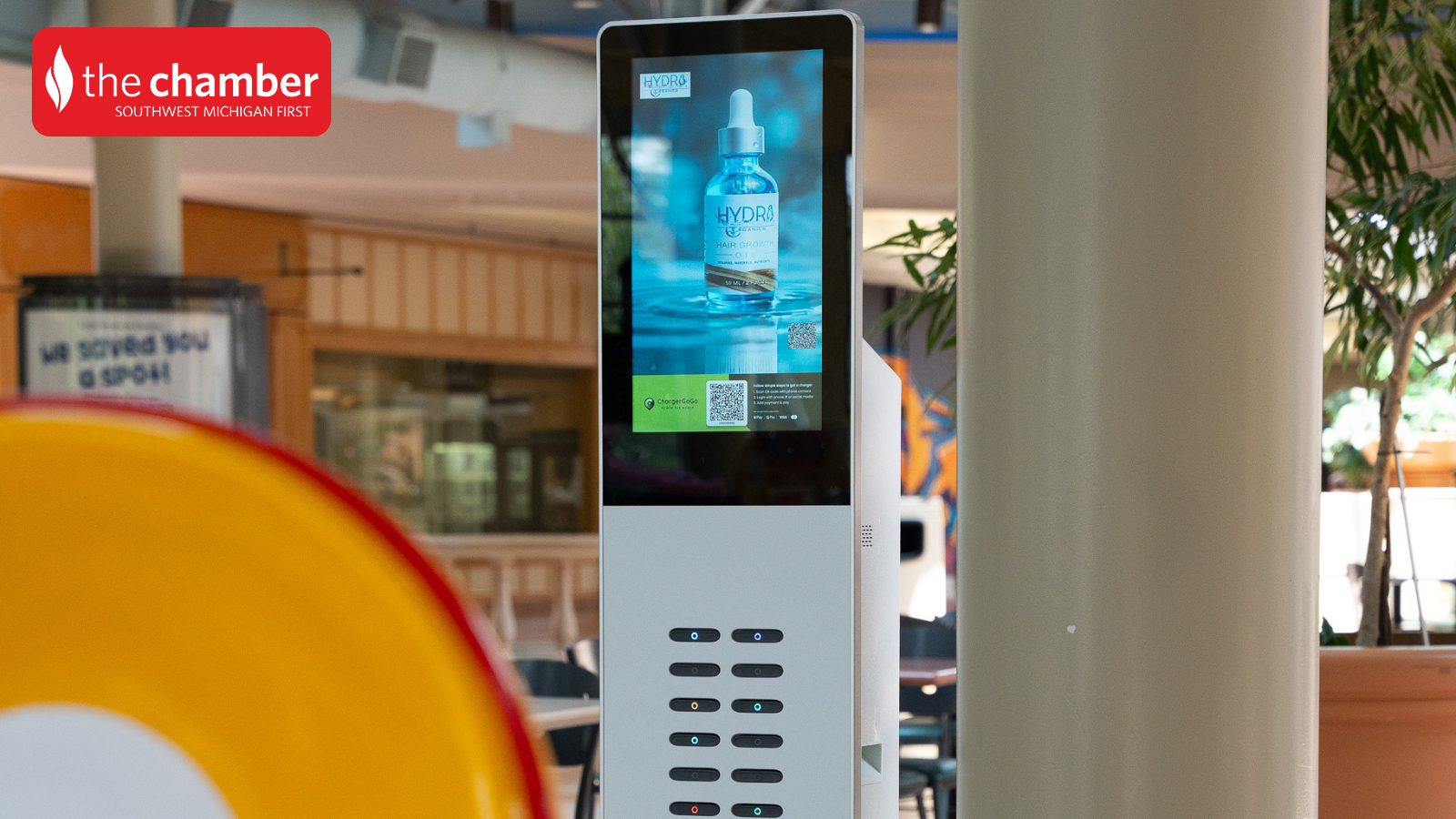
This applies to both physical and digital advertising. A local screen can make a business visible during an everyday errand. A streaming ad can reinforce the same message at home. Search and social channels can help a person find more detail when they are ready to compare options. Each touchpoint has a different job. Plan the combination around a customer journey rather than buying every available format.
Give people one idea to remember. The message should answer a simple question: Why would someone choose you when the need arises? Lead with a specific benefit, a clear business name, and an action that makes sense in that setting. For a business that actually offers them, “Same-day appointments in Portage” is more useful to a nearby customer than a long list of services in tiny type. A short message on a physical screen can point to a website or QR code for more detail; the screen does not need to carry the whole pitch.
Consistency matters too. If a person sees your name on a screen, visits your website, and later encounters a social post, the business should feel recognizable in each place. The wording need not be identical, but the promise, visual identity, and next step should connect. Repetition helps people become familiar with a name; it should not be confused with a guaranteed sale.
Measure the response without overstating the result. Before a campaign begins, agree on what success would look like. A business introducing itself to a new neighborhood may watch searches for its name, website visits from that area, or inquiries that mention where the customer saw it. A business promoting a time-limited service may use a dedicated landing page, a unique QR code, a call-tracking number, or a question asked during intake. Keep those signals alongside the number of inquiries that become real customers.
No single metric tells the entire story. A scan shows interest, not a purchase. An impression doesn’t necessarily mean someone remembers the message. A customer may see several channels before calling. Look for patterns over a reasonable period, ask customers how they heard about you, and adjust the plan when actual response differs from what you expected.
Make visibility a repeatable business decision One useful exercise is to complete four sentences before you spend: “The market I want to grow in is ___. The customers I want to reach are ___. The places and channels that fit their routine are ___. The one thing I want them to remember is ___.” If any answer is vague, the plan needs more work.
This is what I mean by “own your neighborhood.” It is not about claiming every street or appearing on every screen. It is about knowing the community you serve, showing up in meaningful places and giving people a reason to recognize you. As a business grows, it can repeat that same planning process in its next neighborhood or market.
About GridGo Media LLC
Ellis Miller is the Founder of GridGo Media, a company that combines convenient mobile device charging with digital advertising opportunities in high-traffic locations. GridGo Media’s charging towers are placed in locations such as shopping centers, gyms, entertainment venues, and other community spaces, giving visitors a convenient way to charge their devices while providing businesses with highly visible advertising opportunities. Through this unique approach, Ellis and GridGo Media help connect businesses with consumers where they live, work, shop, and spend their time.