
We talk about performance like it’s something we can manage into existence. Set the goals. Track the metrics. Hold people accountable.
But if you’ve led people for any length of time, you already know it doesn’t work that way.
Performance is human. And the moment we forget that, we start building systems and habits that quietly work against the very outcomes we’re trying to drive.
Here’s where I see great leaders get it right, and the mindset shifts that make all the difference.
1. Shift from “hold them accountable” to “set them up to win”
Let’s be honest about something. You cannot hold someone accountable in the way most people mean it.
You can’t force ownership. You can’t demand care. You can’t install follow-through into another human being.
What you can do is create the conditions where accountability naturally shows up. Clear expectations. Real ownership. The right level of support. Feedback that helps someone get better, not just feel corrected.
This is the shift, from trying to control behavior to designing for success.
Instead of asking “Why aren’t they doing this?” start asking “What about the clarity, the system, or the support might be getting in the way?”
When you set people up to win, accountability stops being something you chase and starts being something you see.
2. Stop micromanaging the outcome and start developing the person
Micromanagement usually comes from a good place. You know what great looks like. You can see the gaps before they happen. So you step in and guide the work toward your version of the right answer.
It feels efficient. It’s not.
 When we manage people to our perfect result, we rob them of the development that builds real performance over time.
People are not a fixed asset. When you invest in them, they appreciate. Their capability grows. Their confidence expands. Their contribution compounds. But that only happens when they have space to develop. And most development doesn’t happen in a training room. Research consistently shows that roughly 70 percent of growth comes from real, in-the-moment experience. The trying. The adjusting. The missing and figuring it out.
If every path is pre-paved, there’s no judgment to build. If every decision is made for them, there’s no ownership to step into.
High-performing environments look different. Trying is expected. Effort is recognized. Coaching is woven into how work gets done, not reserved for when things go wrong.
That’s how people grow. And when people grow, performance follows.
3. Stop policing your people and start partnering with them
This might be the most important shift of all and it doesn’t get enough airtime.
People are not waking up thinking about how to make your day harder. They’re not trying to frustrate you or let their team down. They’re showing up with their own wiring, their own strengths, their own blind spots, doing the best they can with what they have.
When you genuinely believe that, it changes everything about how you lead.
You move from frustration to curiosity faster. You ask better questions. You look for root causes instead of assigning blame. And you stop treating people like problems to manage and start treating them like humans worth investing in.
The difference between those two approaches is not subtle. Leaders who police their people create environments where people comply. Leaders who partner with their people create environments where people contribute. Those outcomes are not the same, and your bottom line will tell you which one you have.
When people feel seen instead of suspected, they bring more. More effort. More honesty. More of themselves. That is not a soft outcome. That is a performance strategy.
4. Build self-awareness as a core leadership practice
If you want to be effective with people, you have to understand how people actually experience you.
Not how you intend to show up. How you land.
Because your impact and influence live in that gap.
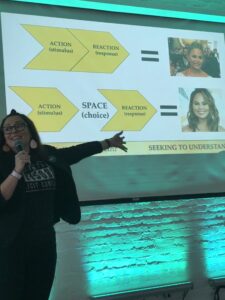 The leader who thinks they are being clear but lands as vague. The one who believes they are being helpful but is experienced as controlling. The one who sees themselves as direct but comes across as dismissive. These gaps do not just create friction. They erode trust, slow progress, and quietly cap what your team is capable of.
Self-awareness is the first step to close those gaps. And from self-awareness stems the real work: the ability to adjust in real time, to lead with intention, to choose your response instead of defaulting to habit.
This is not a personality trait you either have or you do not. It is a practice. It requires consistent attention, not just once at an offsite or during an annual review, but in the everyday moments of leading people.
The leaders who are self-aware enough to self-manage well, do not just become better managers. They become the kind of leaders people actually want to be around, learn from, and work for.
None of this is complicated in theory. All of it is deceptively difficult in practice.
Set people up to win. Give them real space to grow. Stop policing and start partnering. Know how you show up and adjust accordingly.
Do that consistently, not perfectly but consistently, and performance starts to take care of itself. Not because you forced it, but because you built an environment where people can actually do their best work.
And here’s what I know after years of doing this work: when the workplace is working for people, it does not stay inside the four walls of your organization. It goes home with them. It shows up in their communities. It ripples outward in ways that are hard to measure and impossible to ignore.
That is why this work matters beyond the bottom line.
At People Forward®, this is the work we partner with leaders and organizations to do every day. Not as a one-time training or a quick fix, but as a thoughtful, ongoing shift in how you lead, how your teams operate, and how your systems support performance. We help you turn these ideas into practical, lived experiences across your organization so your leaders lead with clarity, your teams grow with confidence, your customers feel the difference, and your results reflect it.
About People Forward
People Forward helps organizations strengthen their teams through practical workforce strategies, leadership development, and people-centered consulting. By focusing on culture, communication, and employee engagement, People Forward partners with businesses to improve retention, enhance performance, and build workplaces where both individuals and organizations can thrive.