

Over the past few months, while meeting with business owners across Michigan, Northern Indiana, and the Chicago region, one comment keeps coming up:
“We have a website… but we’re not sure if it’s actually helping our business grow.”
Many companies launched their website years ago and haven’t revisited it since. Yet today, your website is often the first place a potential customer encounters your business.
After more than 20 years working in marketing and business development with organizations such as Kellogg’s, Amway, and Spectrum Health, and now helping growing businesses through Kinspiration, I’ve found that high-performing websites consistently deliver five key outcomes.
What Businesses Actually Need From Their Website
Most business owners want their website to accomplish five things:
1. Generate leads and sales Turn visitors into calls, quote requests, or consultations.
2. Build credibility and trust A professional website often serves as the first signal that a business is legitimate and trustworthy.
3. Help customers find them online Appearing in search results when people search for nearby services can dramatically expand your reach.
4. Clearly communicate what makes the business different Customers should quickly understand your value and expertise.
5. Answer common questions and save time A strong website reduces repetitive calls and emails by providing clear information.
These goals matter because consumers increasingly research businesses online before making decisions. In fact, more than 80% of shoppers conduct online research before making a purchase, and companies with optimized websites often generate significantly more leads.
A Simple Framework:
Messaging → Visibility → Conversion → Nurturing → Customer Experience
The businesses that see the best results usually build their website strategy around this progression.
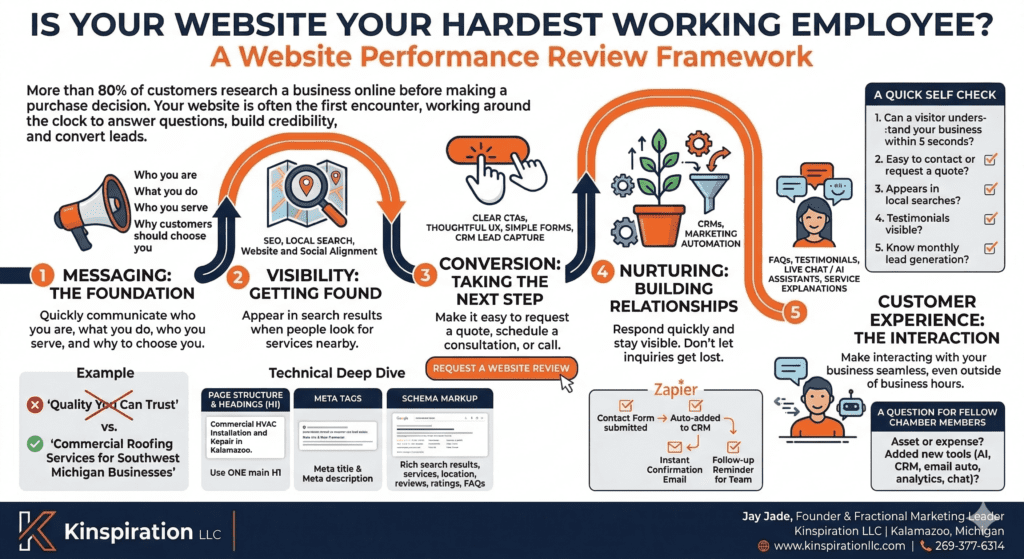
1. Messaging
This begins with branding, positioning, and differentiation.
Your website should clearly communicate:
- who you are
- what you do
- who you serve
- why customers should choose you
Strong messaging often includes storytelling, clear copywriting, and a well-defined value proposition.
Without this foundation, even a well-designed website can struggle to convert visitors.
2. Visibility
Even the best website cannot generate leads if customers cannot find it.
Visibility is typically driven by:
- Search Engine Optimization (SEO)
- local search presence
- alignment between your website and social media channels
Local search has become especially important. For example, studies show that a large share of mobile users contact businesses directly from search results, highlighting the importance of being visible when customers are actively looking.
3. Conversion
Once visitors reach your website, the experience should make it easy for them to take the next step.
Conversion often depends on:
- clear calls-to-action
- thoughtful website design and user experience (UX)
- contact forms and scheduling tools
- lead capture connected to a CRM
Surprisingly, research shows that many small-business websites lack clear calls to action, which can significantly limit their ability to convert visitors into customers.
4. Nurturing
Not every visitor is ready to buy immediately.
This is where systems such as email marketing and automation become valuable.
Tools like CRM platforms and automated follow-ups help businesses:
- respond quickly to inquiries
- share helpful information
- stay top-of-mind with prospects
When implemented well, your website becomes part of an ongoing lead nurturing system, not just a one-time interaction.
5. Customer Experience
The final piece is making it easy for customers to engage with your business.
This may include:
- FAQs and helpful content
- testimonials and project examples
- support tools or chat functionality
- AI-assisted responses for common questions
Research consistently shows that website credibility and user experience strongly influence whether visitors trust a business and choose to engage with it.
6. Balance Matters
Many businesses focus heavily on design. Others prioritize user experience. Some invest heavily in copywriting or branding.
But the websites that perform best usually balance branding, messaging, design, UX, and marketing systems together, built around how customers actually evaluate a business.
One simple question I often ask clients is:
When was the last time you reviewed your website from your customer’s perspective?
Or even better, when was the last time you asked your customers for feedback on it?
Small insights from real customers often lead to meaningful improvements.
A Question for Fellow Chamber Members
I’m curious to hear how other businesses think about their websites.
- Do you feel your website is currently an asset for your business, or more of an expense?
- Have you recently added any features or tools that improved performance?
Examples might include:
- AI tools
- CRM integrations
- email automation
- analytics platforms
- customer chat tools
It would be interesting to hear what others have found most impactful.
A Final Thought
A website should not simply function as an online brochure.
When built strategically, it becomes a central hub for marketing, credibility, lead generation, and customer engagement.
Even small improvements to messaging, visibility, or lead capture can create meaningful business results.

Jay Jade – Kinspiration LLC
About Kinspiration LLC
Kinspiration LLC provides fractional marketing leadership and execution for small to mid-sized businesses, helping organizations strengthen their messaging, improve visibility, and convert more opportunities into measurable growth. With a strategic, data-informed approach, Kinspiration works alongside business owners to align marketing systems, enhance customer experience, and build sustainable pipelines for lead generation and long-term success.
Sources
- https://www.forbes.com/councils/theyec/2020/02/03/why-every-business-needs-a-website/
- https://www.networksolutions.com/blog/small-business-website-statistics/
- https://digitalseoland.com/blog/local-seo-statistics/
- https://www.wix.com/blog/small-business-website-statistics
- https://www.monsterinsights.com/reasons-why-website-analytics-is-important-for-your-business-growth/