
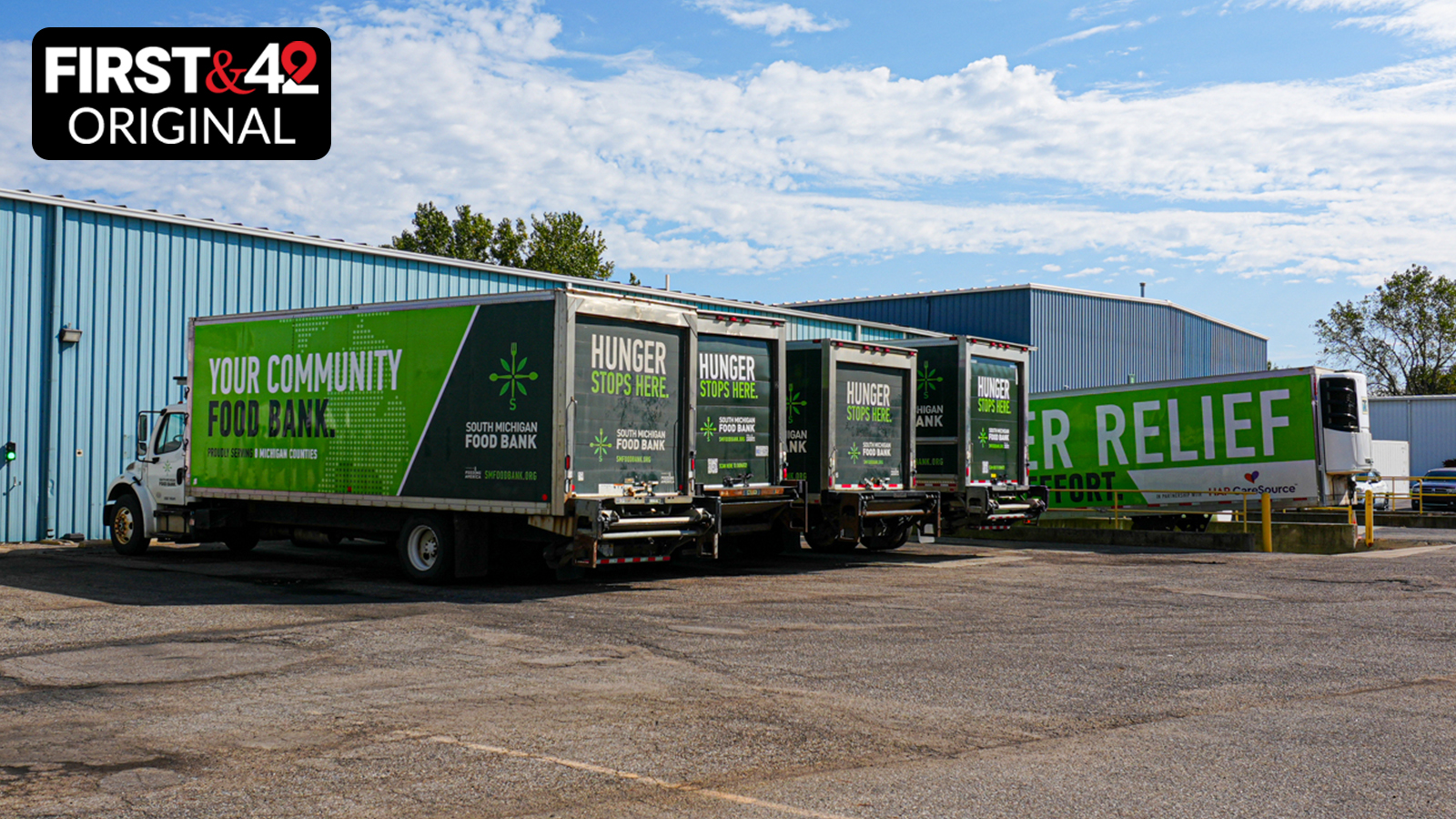
A box truck eases into a Kalamazoo parking lot on a warm weekday afternoon. Volunteers unfold tables and set out baskets of bright produce, loaves of bread, and ready-to-cook meal kits with simple recipes tucked inside. Neighbors step forward, take their time, and pick what they will actually use. There’s no ID check, and it feels like a small outdoor market that shows up where it is needed most.
That quiet scene says a lot about South Michigan Food Bank and where the organization is headed. The food bank has served this region for more than four decades. It began in the early 1980s and now marks its 44th year. The service area covers eight counties, supported by a regional network of partners and trucks that move food into local communities. The warehouse turns over fast, which means food does not sit around. It comes in, it goes out, and families eat.
Peter Vogel, CEO of South Michigan Food Bank, puts the footprint simply, “The South Michigan Food Bank covers eight counties along the Indiana border.” He also points to the engine behind it, saying, “A food bank is really the warehouse. We have 390 distribution partners scattered throughout our eight counties.”
The impact is wide and the focus is clear. Two ideas shape what happens next.
- Food should support health.
- Access should be mapped and delivered with care and accuracy.
The first idea comes to life in the Fresh Food Pharmacy, a partnership that connects health care and hunger relief. Logan West, Nutrition and Health Programs Manager, said it was designed “to test a replicable model for food bank and federally qualified health center partnerships.” West oversees the program along with Amanda Freighner and Dr. Dawn Opel at the Food Bank Council of Michigan.
Patients managing chronic disease and struggling with food insecurity can enroll to receive a fresh food box prescription and nutrition education. The program aims to demonstrate measurable health improvements and return on investment so results can inform policy, including potential coverage under Medicaid.
The food in those boxes follows a clear standard, and the aim is to provide foods that help people feel better and live better. As West puts it, “At the pantry, the focus is around foods that support a healthy lifestyle. This means providing foods with little to no added salt or sugar, fresh produce, dairy, whole grains, lean meats, plant-based protein-rich foods, and primarily whole foods.”
Education is part of the promise too. Participants meet monthly with a healthy lifestyles coach to set goals, learn cooking skills, assess their current diet, and make realistic changes. After graduating, options continue with dietitian-led farmers market trips, healthy lifestyle coaching, and more.
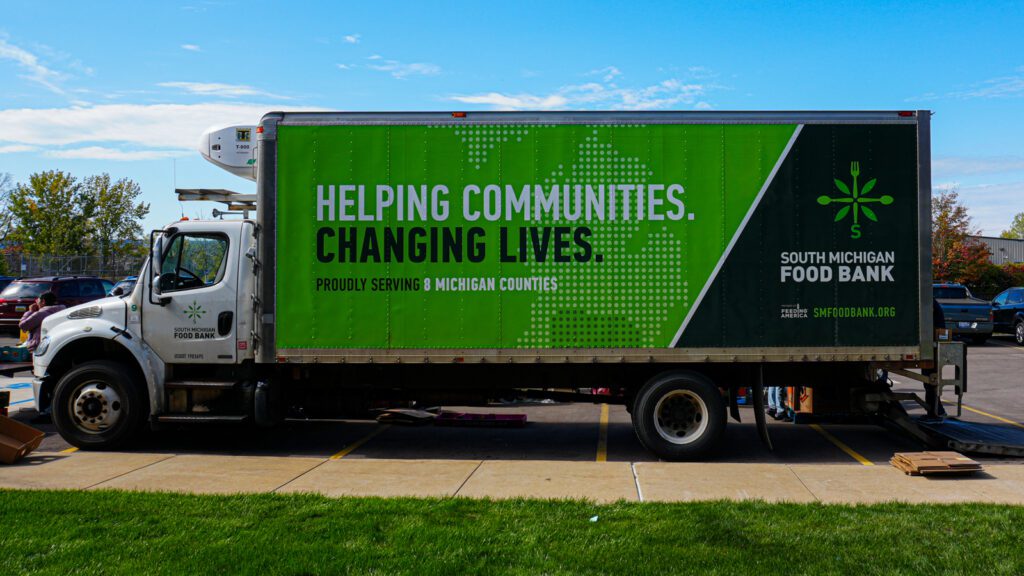
Kalamazoo County mobile market on Friday, Oct. 10. Participants pick what they need, select a meal kit, and receive the packed box from staff at the end of the line.
Vogel ties the same idea to what shows up on tables across the region. “One of the things we’ve done in the last few years is really increase how much fresh, Michigan-grown fruits and vegetables we’ve been able to get out. One of the ways we’ve done that is with our mobile markets. People are living healthier lives. And so that’s really what we’re looking for more than anything.”
The second idea lives on wheels. During the pandemic, many local pantries shifted to drive-through service. It kept people safe, but it removed choice. South Michigan Food Bank chose to rebuild that choice and bring it closer to people who had few options.
“The main reason we started Mobile Markets was to provide resources in areas that needed it,” Lori Sunie, director of development, said. “We focused on areas where there weren’t other agency partners and food deserts. We also wanted to be able to offer our participants a choice and allow them to pick what food they would want and use. When COVID-19 hit, we lost most of our choice pantries and many went to the drive-through model and haven’t gone back to the choice pantry since.”
Putting that vision on the road meant deciding where the markets could do the most good. The team turned to Map the Meal Gap and U.S. Census data to pinpoint need and avoid overlap with existing agencies. Vogel said they look to local funders and community foundations to support placement. “We’re kind of helping make that a community decision to decide where we want to go.”
When the truck arrives, the experience is simple and human. People get to choose. “The main reason that our Mobile Markets are different than other typical food distributions is that we offer our participants a choice in which meal kit they select,” Sunie said. “They get to choose from four different meal kits and everything they need to make that meal is included inside, including protein and a recipe. Participants are also able to shop from a variety of other items including produce and dairy.”
That approach changes how neighbors see the food bank. Staff are present, answering questions and explaining how the model works. “Neighbors are happy to see the food bank out in the community and see the amount of food we are directly distributing,” Sunie said. “Many neighbors were not aware of the extent of what the food bank does until they have been to our mobile markets. Our staff being at the mobile markets helps to educate communities about what we do and who we partner with.”
Behind the scenes, a lot must go right to make these programs work. The food bank is part of the Feeding America network and coordinates with national retailers through store rescue programs. Target, Aldi, Costco, Dollar General, Walmart, and Sam’s Club are among the partners that help move surplus food into the community instead of into a dumpster. The team also works closely with pantries across the region and maintains a steady presence in places like Jackson.
Volume tells another part of the story. “We’re moving somewhere between 11 and 12 million pounds of food every year out of a 30,000 square-foot facility,” Vogel said. “We’ve really created a network… so that people can walk if possible.”
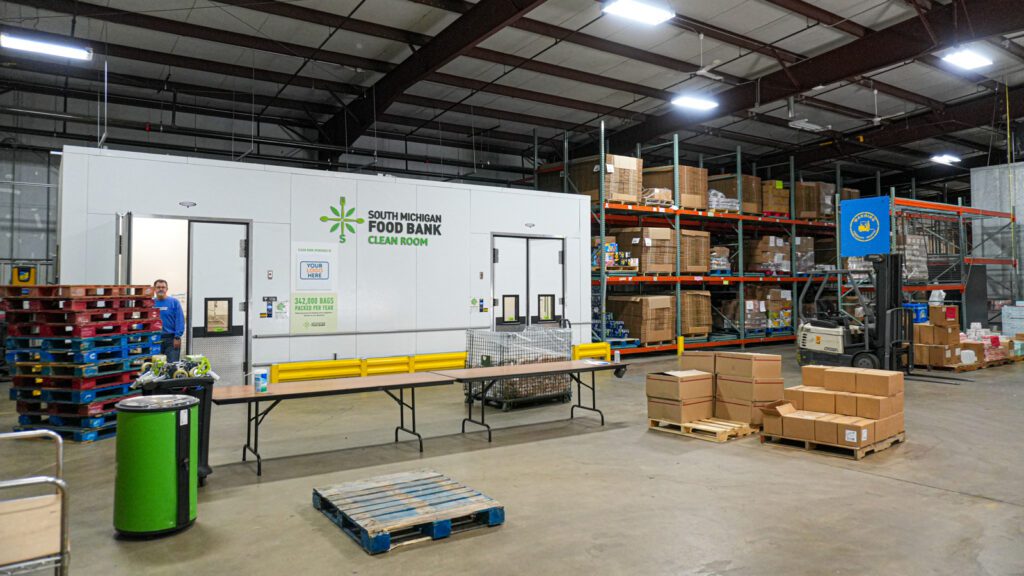
Inside South Michigan Food Bank’s warehouse, the clean room and staging area where boxes are prepped for distribution to partner agencies and mobile markets.
Looking ahead, the plan is to deepen what already works. Expanding nutrition-focused programs, offering more medically appropriate foods, and keeping fresh, nourishing options in front of people. “We have expanded our Mobile Markets this year to at least one in every county, focusing on the food deserts and areas with limited resources. As we continue to expand our Mobile Markets, we plan to offer more fresh fruits and vegetables when available, and when they aren’t available, focusing on more frozen fruits and vegetables.”
Under its next phase, South Michigan Food Bank is concentrating on depth rather than size by scaling Food as Medicine, widening access, and refining what goes into people’s carts. “Expanding our work in the Food as Medicine space and increasing access to foods that promote health and wellbeing are priorities of South Michigan Food Bank.”
Delivering on those goals relies on the organization’s networked model. Programming and agency partnerships anchor operations in local neighborhoods, while community collaboration, grant support, and individual giving supply the resources to keep trucks moving. Donors, staff, volunteers, and 390 distribution partners work together so food flows quickly from the warehouse to places where it will be used.
The financial and supply environment remains tight, which shapes day-to-day decisions. “This year, we’re sitting right at 15% of the food that we’re getting coming in from federal programs,” Vogel said. Before COVID, annual volume hovered near seven million pounds; today it holds at 11 to 12 million, which requires steady coordination to maintain. “We’re going to try to control what we can control. And that’s our promise to the community.”
Back in the parking lot, the market winds down. A volunteer answers a question about the recipe kit. A parent adds potatoes and bread to a tote bag. Someone thanks a staff member and asks when the next market will be back. The truck door slides shut, and the team begins the drive toward the warehouse, where another load is already waiting.
This is a simple picture, and that’s why it works. Food that supports health and access mapped with care. Trucks that arrive where the data says they should. A network that moves quickly and treats people with respect. The story of South Michigan Food Bank is not about a single event or headline, but a steady system that helps neighbors eat well today and build better habits for tomorrow.
About South Michigan Food Bank
South Michigan Food Bank is a partner of Feeding America serving eight counties in south-central Michigan. From its Battle Creek headquarters at 5451 Wayne Road, the team stores and distributes food from a 30,000 square-foot warehouse and moves it to local communities through deliveries and a network of more than 380 partner agencies. Programs focus on getting nutritious food to where it is needed. Mobile Markets bring healthy options directly into neighborhoods to reduce travel barriers. Nutrition Initiatives include the Fresh Food Pharmacy, developed with Grace Health, which pairs produce prescriptions with nutrition coaching. Additional efforts include Fresh Food Distributions, the Backpack Program, CSFP, and work in the Clean Room to package family-size portions. Learn more at www.southmichiganfoodbank.org